
Plug-In Solar Panels: Are They Worth It?
Since 27 August 2026, you can nip into a B&Q, Screwfix or Argos, pick up a solar panel, take it home and plug it into a socket. No installer, no scaffolding, no MCS paperwork.
It’s been all over the news, and it comes up in a bunch of consultations.
With our mission being to ‘Improve Solar for Everyone‘ we’re here to provide an informative look at Plug-In Solar’s benefits and limitations, how it stacks up against a certified Solar Installation to allow you to make an informed decision if it’s right for you.
About Plug-in solar: Key details
- 800W maximum per device (typically consisting of two 400W panels)
- One device per power circuit protected by its own breaker at the consumer unit
- Great Britain only — England, Scotland and Wales. Northern Ireland is not covered
- No battery storage. Plug-in batteries were explicitly left out of scope pending a separate safety review
- Between £700 – £1,200 is the system typical cost currently, the government expects this to settle around £400 – £600 once competition increases and the market settles
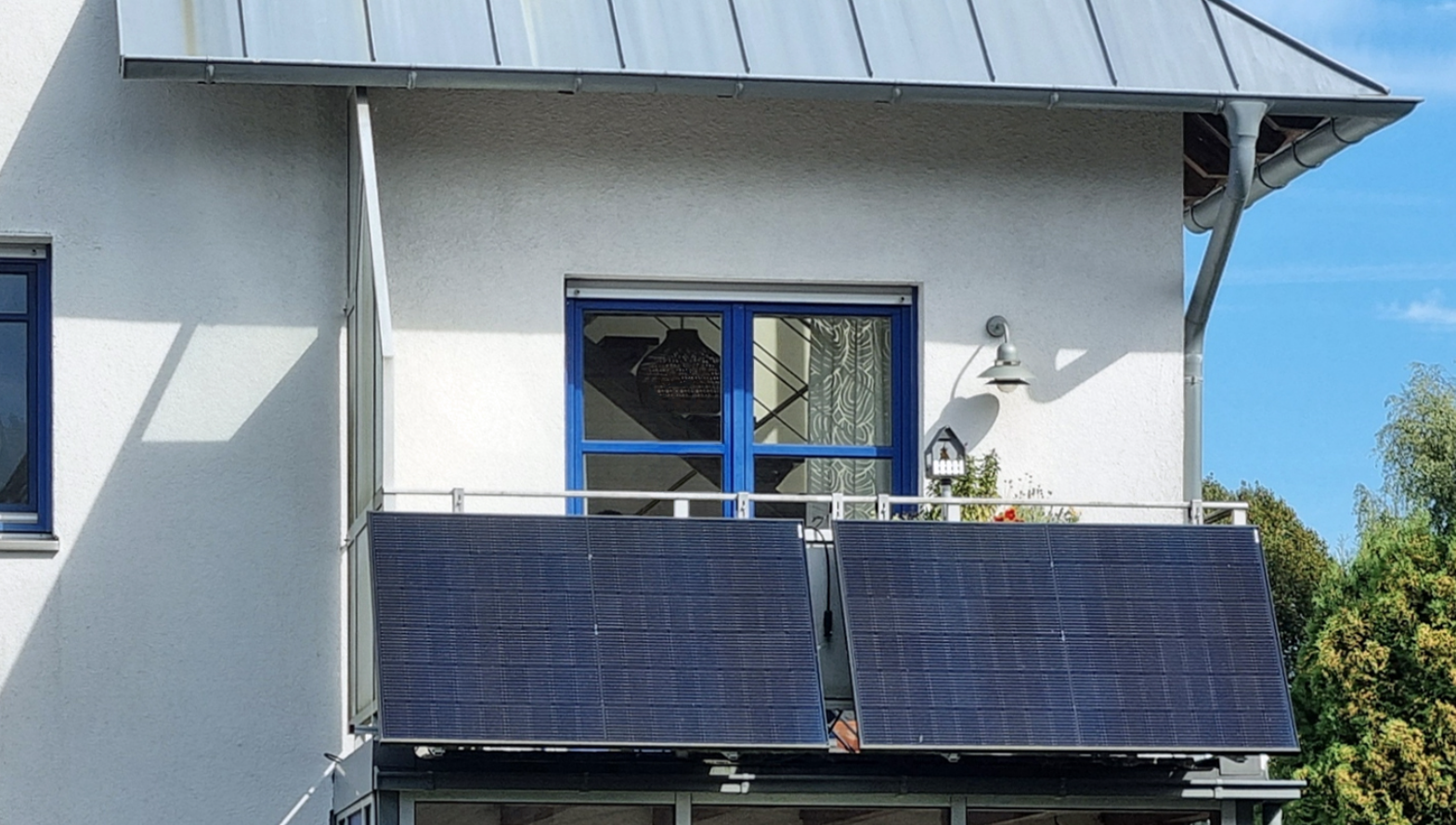
Plug-in or Balcony Solar panels are now legal in the UK
Our big conern with Plug-in Solar panels
A plug-in kit pushes electricity backwards into your home through a normal 13A socket. Your sockets sit on a ring circuit protected by a 32A breaker, and that breaker only sees current leaving the consumer unit — not current injected halfway round the ring from a socket behind the sofa.
You’re adding a second power source to a circuit designed on the assumption there was only ever one, and the protection doesn’t even know it exists. Whilst nothing dramatic happens on day one, the worry is a thirty-year-old socket with tired terminals carrying current both ways, every sunny day, for years will eventually burn out.
And we’re not alone: the ECA, Electrical Safety First, the IET, NICEIC and SELECT — jointly warned that installing without checking the wiring first “could raise the risk of cables overheating“, and at worst “fire or electric shock“.
“Before anyone buys a plug-in solar kit from a supermarket shelf, they need to be aware of the condition and capability of their home’s wiring. Many UK homes have ageing, modified or poorly maintained electrical installations. Introducing a generating source into wiring that hasn’t been checked could expose homeowners to risks that are not immediately obvious.” — Mark Coles, Head of Technical Regulations at the IET.
Plug-in solar panels vs certified solar installation
| Plug-in Solar | Fully Accredited MCS Solar System | |
| Ready to go system (no installer, no scaffolding) | ✅ | ❌ |
| Portable system when you move | ✅ | ❌ |
| Works on a rented flat balcony | ✅ | ❌ |
| Expertly Installed by a qualified electrician | ❌ | ✅ |
| Your circuits assessed first | ❌ Your responsibility | ✅ Surveyed by an expert |
| Wired into a protected circuit | ❌ Plugs into a socket | ✅ |
| DNO | ❌ Your responsibility | ✅ Handled for you |
| Get paid for surplus energy (SEG) | ❌ | ✅ MCS Certified |
| Store energy for when you need it most | ❌ | ✅ When partnered with Battery Storage |
| Back up capabilities in Power Cut | ❌ | ✅ When partnered with Battery Storage |
| Integration with EV Charging, hot water | ❌ | ✅ |
| Adds value to your property | ❌ | ✅ |
The 800 W is a ceiling, not a yeild
It’s the biggest misunderstanding we’re hearing in consultations. People see “800W”, picture two panels running at 800W through the middle of a sunny day, and work backwards from there. That isn’t what happens. 800W is a legal ceiling on what the inverter is allowed to push into your house, not a yield you can count on.
Pitch, shading and the path of the sun across the sky all pull generation down, so you’re only near the top of the curve for a relatively short window either side of noon. Panels also get hot in strong sun, and hot panels are less efficient — that’s another 10% or so gone on a summer afternoon.
To give you a comparison, here’s what a plug-in kit looks like next to a 5kWp system — roughly twelve panels on a roof, which is a fairly ordinary family-home install.
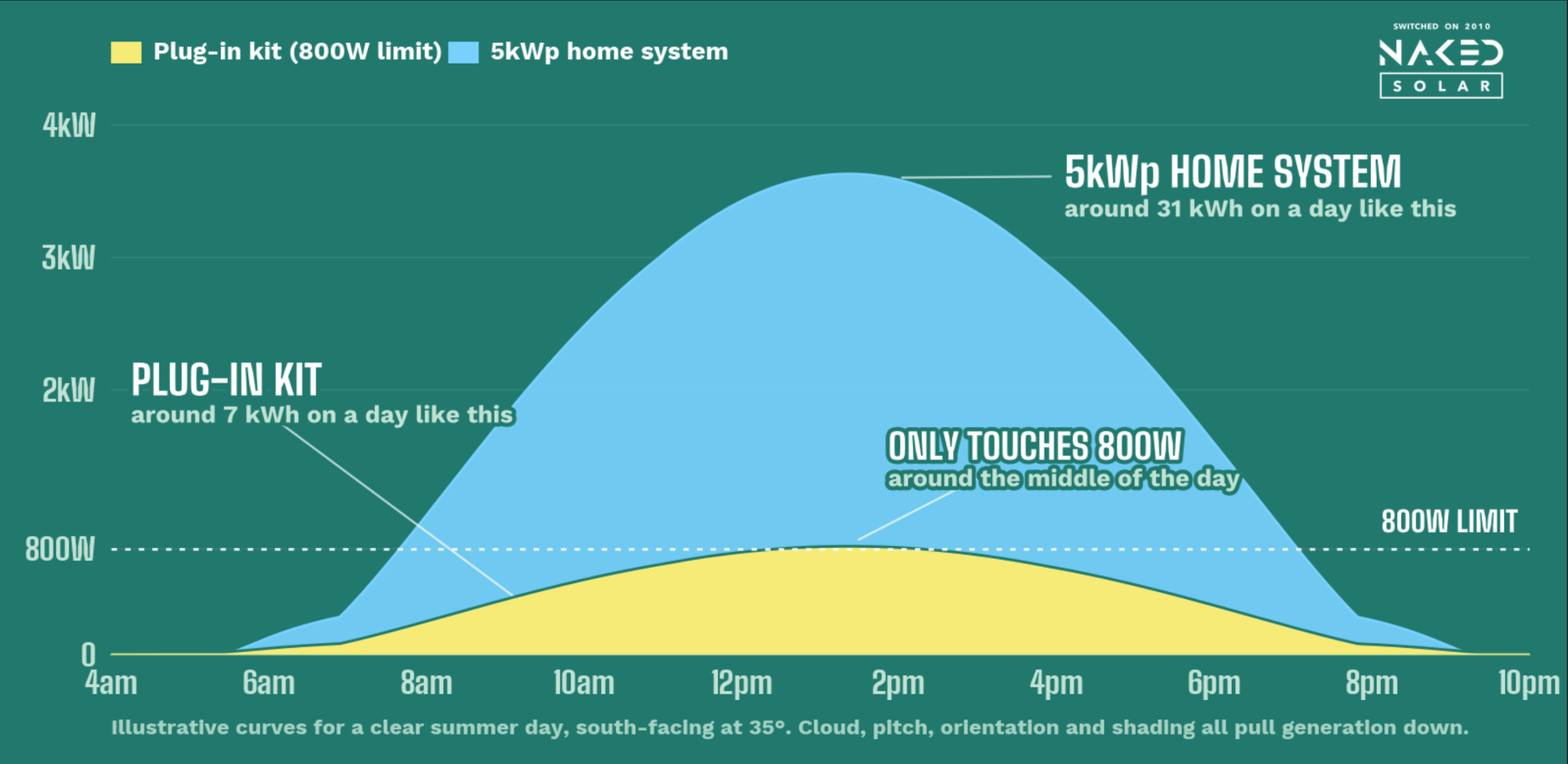
Reading the chart above: yellow is a plug-in kit, blue is an ordinary roof-mounted system — same house, same day. The dotted line is the 800W a plug-in kit is legally allowed to deliver, and even on a clear summer day the yellow only touches it for a short window around the middle of the day (Good news if you’re a fan of Loose Women: the middle of the day is exactly when a plug-in kit is doing its best work) before falling away again. Across the whole day the plug-in kit makes around 7 kWh, in comparison the rooftop system makes around 31 kWh.
How much can you save with Plug-in solar?
The Government estimates you can save up to £110 a year. We wanted to test that rather than repeat it, so we modelled it properly using our advanced design software.
We put two systems on the same Newquay house in PV SOL — the design software we use to specify every system we install — and ran both against the same household, the same 2,500 kWh a year of consumption and the same 26.39p unit price. One is a compliant 800W plug-in kit. The other is a typical twelve-panel install: 5.4kWp with a 5.2kWh battery.
| Plug-in solar | 5.4 kWp solar + battery storage | |
| System Breakdown | 2 panels, 0.8kWp | 12 panels, 5.4kWp, 5.2kWh Fox EP6 |
| Investment cost | £800 (Average current market cost) | £12,364 |
| Annual generation | 873 kWh | 5,577 kWh |
| Annual Savings | £191 | £959 |
| Self-sufficiency | 29.3% | 83.0% |
| Payback | 3 years 11 months | 11 years 2 months |
| Benefit over 25 years | £6,850 | £25,139 |
Modelled in PVSOL for a Newquay property, south-facing at 35°, PVGIS climate data. Electricity at 26.39p per unit rising 6% a year. Export paid at 12p for the MCS-certified system, and nothing for the plug-in kit, which cannot claim the Smart Export Guarantee.
Annual savings is what you stop paying your supplier, plus anything you’re paid for exporting. The plug-in kit earns nothing from export — without MCS you can’t claim the Smart Export Guarantee — so all £191 comes off the bill. Of the full system’s £959, about £542 is bill savings and £418 is export income.
Self-sufficiency is the share of everything your house uses that comes from your own roof rather than the grid. It’s the number that tells you how exposed you still are to the next price rise.
Payback is the point where cumulative savings pass what you spent. Under four years for the kit, just over eleven for the full system.
Benefit over 25 years needs explaining, because the two products don’t age the same way. A plug-in kit is warranted for ten years. Our software, left to itself, assumes one kit running for the full twenty-five and prints £8,451 — but that isn’t a fair comparison against panels warranted for twenty-five to thirty. Buy the kit three times over that period, as you realistically would, and you spend £2,400 to save £9,251. Net: around £6,850.
You’ve got to be at home to benefit from Plug-in solar
Another key consideration for homeowners looking at plug-in Solar is around their lifestyle, and typically if they’re at home during peak hours to make use of the generation. With Battery Storage and SEG Payments off the table, a plug-in kit saves you money on the electricity you happen to be using at the exact moment it’s generated, everything else goes to the grid, unpaid.
Conclusion – Are Plug-in solar panels worth it?
The reality is millions of UK households can’t put panels on a roof. We want Solar to be brought to the masses, so it’s great to see the market innovating to achieve this.
We’d just rather people bought it with clear eyes. The safety framework is new, the compliant product list is short, the protective devices in most British homes were never designed for power flowing the other way, and the savings depend far more on your daily routine than on the kit you choose.
Plug-in solar might be worth considering if:
- You rent, or live in a flat, listed building or conservation area — anything that rules out a proper installation
- You’re home during the day and want to dip a toe in without a big financial commitment
- You want a modest, immediate saving on the bill rather than a big project — realistically £40 to £200 a year, with no installer and no scaffolding
- You’re willing to get an electrician in first to look properly at your setup and confirm it’s safe
- You expect to move, and like the idea of taking it with you
But if what you’re really after is true energy independence, a plug-in kit won’t get you there. It’s a small appliance that shaves a bit off your daytime usage, and that’s the whole of it.
A proper system is a different proposition, and the technology has moved on a long way. With Solar and Battery Storage you can:
- Make savings that provide genuine protection against a volatile energy market – more and more of our customers are actually seeing negative bills
- Get paid for the surplus you export instead of giving it away
- Send spare generation to a battery, an EV charger or the hot water tank rather than the grid
- Pull in cheap overnight units when the tariff suits
- Protect against power cuts with home backup
If you’re considering either, it’s worth a conversation
If you’re weighing up Plug-In Solar against a full Solar installation, wondering whether your home is a good candidate, or just want a quick chat on options, we’d be thrilled to help you decide, including if the answer is neither. We’re 100% impartial, we never take commission, and a handful of our reviews are filled with praise for ‘unselling’.