- How do I know if I’ve already got surge protection?
Take the cover off your consumer unit and have a look by your inverter isolator. You’re after a module with a small window on the front, usually about the width of two fuses. Green means it’s working, red means it’s done its job and needs replacing. If you can’t see one anywhere, you probably haven’t got one.
- Do they need replacing?
Yes — they’re sacrificial. Every surge they absorb uses up a bit of their capacity, and the indicator window changes colour when the device has expired (changes from green to red).
- How much does surge protection cost?
It depends on the system, but typically between £500 and £1,000 fitted. That covers the devices for both the DC and AC side, the enclosures they sit in, and the labour. It appears as a priced line on your quote rather than being folded into a total, so you can see exactly what it is.
- Why isn’t surge protection on my other quotes?
Usually one of two reasons. Either it has been left off to keep the headline price down — in which case you’d be asked to sign a declaration before the work went ahead — or the installer believes the inverter or battery has already provided surge protection (not the case).
The second is the more common and the more understandable. Many inverters and battery systems do contain varistors on the DC side, and it looks like protection. BS 7671 is explicit that it isn’t: “Varistors included in the inverter are not considered as SPDs.” Devices built into an inverter only count if the manufacturer has specifically stated they’re suitable for protecting the DC side of a PV installation — and if they haven’t, external SPDs are required.
- Can I ask you to leave surge protection off my installation?
Yes – your installation, your choice! It’s important to not that wiring regs only allow it to be left out where the owner declares in writing that it isn’t required and accepts the risk, so rather than just taking it off the quote we’ll send you the full explanation and a declaration to agree to.
- Will it stop a direct lightning strike?
No — and be wary of anyone who says it will. A direct strike needs a full lightning protection system: air terminals, down conductors and earthing, designed to BS EN 62305
Do I Really Need Surge Protection?
Surge protection is one of the smaller items on a solar quote and one of the least understood. It’s a component that sits in your fuse board and alongside your inverter to protect all your equipment from damaging electrical surges.
To help you decide if surge protection is for you, we’ll lay out what a surge protection device does, where it goes on a solar system, and what the wiring regulations say about.
What is an electric surge?
An electric surge is a sudden increase in voltage in an electrical system. Surges can be caused by a variety of internal and external factors; common causes of electric surges are:
- Lightning strikes, both direct and indirect
- Damage to power lines
- Faulty appliances
- Faulty wiring
- Power cuts
- Tripping circuit breakers
- High powered devices being turned on/off
What does a Surge Protection Device do?
A Surge Protection Device is essentially a pressure release valve for electricity.
Inside is a component that behaves like an open switch at normal voltage — power flows past and nothing happens. The moment voltage spikes above a set threshold it turns conductive in nanoseconds and diverts the excess energy straight to earth, before it reaches electrical equipment such as your solar PV inverter or Battery. Once the spike has passed, it returns to normal operation.
Where surge protection goes?
A properly protected system has surge protection on both sides of the inverter.
On the DC side, between the solar array and the inverter — protecting the inverter from anything the roof picks up.
On the AC side, between the inverter and your consumer unit — protecting the inverter from whatever the grid throws at it, and protecting the rest of the house from the inverter’s circuit.
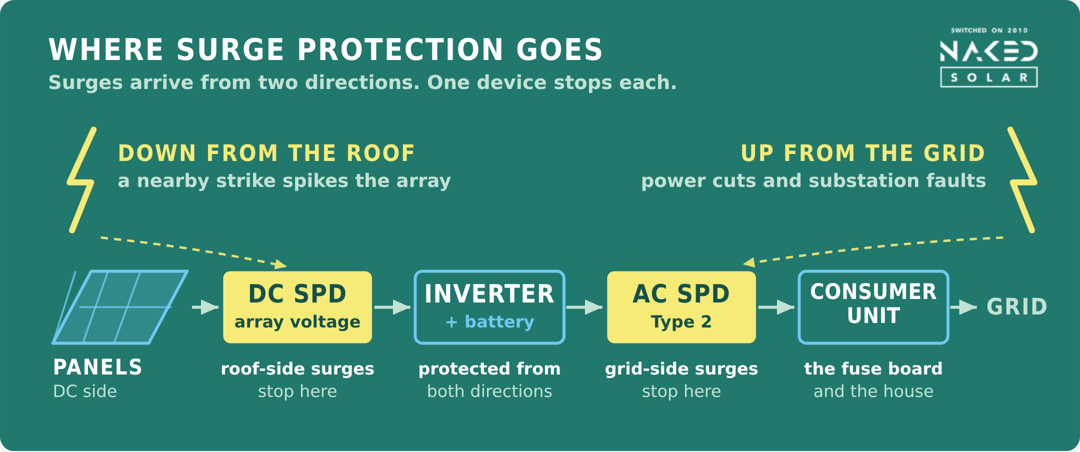
A note on inverters that claim to have it built in. Plenty of inverters and battery systems contain ‘varistors’ on the DC side. For a customer or an installer — to assume that counts as surge protection. The regulations are specific that it doesn’t, unless the manufacturer has stated it does, more on this this below
Why surge protection is key for solar installations
Your rooftop PV functions essentially as a large-scale areial loop. When a storm passes by overhead, those loops pick up an induced current – similar to the way a radio aerial picks up a signal.
Whilst panels themselves are fairly robust, the inverter is a box of precision power sitting at the end of your DC cable run, and the first thing to fail after a nearby strike. If your installation also includes Battery Storage, there’s another peice of expensive technology exposed on the same circuit.
In Summary: An unprotected installation is exposed to costly issues – A replacement inverter runs between £1,200 and £2,500, with labour, scaffold and the cost of lost generation also added into the mix. Application of a Surge Protection Device (SPD) provides critical fault mitigation and delivers you peace of mind your precious system is protected.
What do the regulations say?
Here is regulation 443.4.1 from the current UK electrical regulations (BS7671)
Protection against transient overvoltages shall be provided where the consequence caused by the overvoltage could result in:
- Serious injury to, or loss of, human life
- significant financial or data loss
For all other cases, protection against transient overvoltages shall be provided unless the owner of the installation declares it is not required due to any loss or damage being tolerable and they accept the risk of damage to equipment and any consequential loss.
Surge Protection - Frequently Asked Questions